
Magnesium Glycinate vs Citrate: Which One Should You Choose?
Aug
Reviewed against the product labels in August 2026
If you are comparing magnesium supplements in Bangladesh, the bottle labels can be confusing. One product may say “500 mg magnesium glycinate” on the front but show only 90 mg of magnesium in the Supplement Facts panel. Another may provide 400 mg of elemental magnesium from a much larger amount of magnesium citrate. So, which is better: magnesium glycinate or citrate? The short answer is that neither form is best for everyone. The more useful choice depends on the elemental magnesium per serving, digestive tolerance, serving size, added ingredients and advice from your healthcare professional.
Quick answer
Magnesium glycinate is magnesium bound to the amino acid glycine and is often selected when digestive tolerance is a priority. Magnesium citrate is magnesium combined with citric acid; it is well absorbed compared with magnesium oxide but can be more likely to loosen the stool. Do not choose from the biggest number on the front of the bottle. Compare the elemental magnesium in the Supplement Facts panel and the number of tablets or capsules in one serving.
What do magnesium glycinate and magnesium citrate mean?
Pure magnesium is not used by itself in a supplement. It is joined to another substance to create a magnesium compound. The name of that compound tells you the magnesium form.
Magnesium glycinate
Magnesium glycinate—often called magnesium bisglycinate—is magnesium bound to glycine. It is widely chosen by people who want a form that may be gentler on the digestive system. You will sometimes see it promoted for sleep, stress or muscle relaxation, but a supplement label alone does not prove that the product will treat any of these concerns. The quality of the evidence depends on the specific health outcome, dose and person.
Magnesium citrate
Magnesium citrate combines magnesium with citric acid. Human research has found citrate to be better absorbed than magnesium oxide in the preparations studied. It may also draw water into the bowel and loosen the stool, especially at higher amounts. This can be useful in some medical situations, but it can also be an unwanted effect. Medicinal magnesium citrate is used as a short-term laxative; an ordinary dietary supplement capsule should not automatically be treated as the same product or used for constipation without professional advice.
Important evidence point: Direct, high-quality research proving that glycinate is always better than citrate—or citrate is always better than glycinate—is limited. Product quality, elemental dose, digestive response and individual health needs matter more than a universal “winner.”
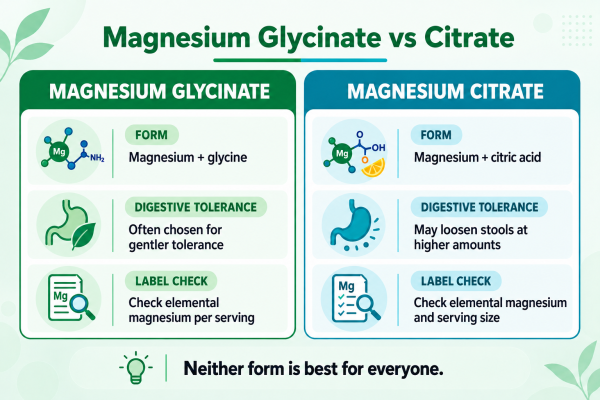
Magnesium glycinate vs citrate: the practical differences
| Point to compare | Magnesium glycinate | Magnesium citrate |
|---|---|---|
| What it is | Magnesium bound to glycine | Magnesium combined with citric acid |
| Digestive effect | Often chosen when a gentler digestive experience is preferred | May be more likely to produce loose stool, particularly at higher amounts |
| Absorption | Commonly marketed as well absorbed, although direct comparisons with citrate are limited | Published human evidence supports good absorption compared with oxide |
| What to check | Elemental magnesium, number of capsules, added ingredients and whether the capsule is vegetarian | Elemental magnesium, serving size, divided-dose directions and digestive tolerance |
| May be a practical option when | You and your healthcare professional prioritise tolerance and prefer the glycinate form | You prefer citrate, tolerate it well and want a form with evidence of absorption |
Magnesium oxide is another common form. It can provide a high amount of elemental magnesium in a small tablet, but it is generally less bioavailable than citrate and several other forms. That does not make every oxide product unsuitable; it means the form, dose, tolerance and reason for use should be considered together.
Why does a bottle say 500 mg but provide less elemental magnesium?
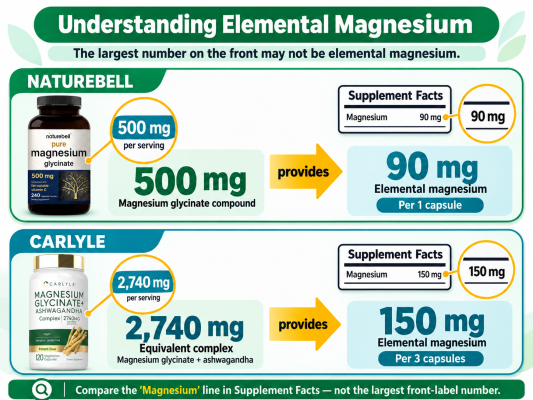
This is the most important label-reading lesson in this comparison. The number on the front may describe the weight of the whole magnesium compound, not the magnesium contained within it. The compound also includes glycine, citrate or another binding substance. The Supplement Facts panel must separately declare the amount of elemental magnesium supplied by the serving.
For example, the label of NatureBell Pure Magnesium Glycinate lists 500 mg of magnesium glycinate per capsule, while its Supplement Facts panel declares 90 mg of elemental magnesium. The remaining weight belongs to the glycinate portion of the compound; it is not “missing” magnesium.
The Carlyle formula offers another useful example. Its front label highlights a 2,740 mg equivalent complex. The facts panel explains this as 1,240 mg of magnesium glycinate plus an ashwagandha extract equivalent to 1,500 mg of root. The actual elemental magnesium is 150 mg per three-capsule serving. Therefore, 2,740 mg should not be compared directly with a product that declares 300 mg or 400 mg of elemental magnesium.
The simple label rule
Turn the bottle around. Find the line that says “Magnesium” in the Supplement Facts panel and note its amount per serving. Then check the serving size. That is the elemental amount to use when comparing products—not the largest number printed on the front.
Six magnesium product labels compared
The table below uses the front and back labels displayed on the six Be Healthy BD product pages. It is a label comparison, not a ranking or personal dosage recommendation.

| Product | Form | Label serving | Elemental magnesium | Useful label detail |
|---|---|---|---|---|
| NOW Magnesium Glycinate – 180 tablets | Magnesium bisglycinate | 2 tablets | 200 mg | The facts panel states that the 200 mg of magnesium comes from 2,000 mg of magnesium bisglycinate. |
| Nature’s Bounty Magnesium 500 mg – 100 tablets | Magnesium oxide | 1 tablet | 500 mg | Here the facts panel declares 500 mg of elemental magnesium as magnesium oxide. |
| Carlyle Magnesium Glycinate + Ashwagandha Complex – 120 capsules | Magnesium glycinate plus ashwagandha | 3 capsules | 150 mg | The highlighted 2,740 mg is an equivalent complex figure; it is not 2,740 mg of elemental magnesium. |
| NatureBell Magnesium Glycinate, Citrate & Malate Triple Complex – 240 capsules | Glycinate, citrate and malate | 2 capsules | 300 mg | The label lists 1,000 mg total from the three magnesium compounds but does not state the elemental contribution of each form separately. The capsule contains gelatin. |
| NOW Magnesium Citrate – 120 veg capsules | Magnesium citrate | 3 capsules | 400 mg | The 400 mg elemental amount comes from 2,667 mg of magnesium citrate. |
| NatureBell Pure Magnesium Glycinate 500 mg – 240 capsules | Magnesium glycinate | 1 capsule | 90 mg | The 500 mg on the front refers to magnesium glycinate compound weight; the facts panel shows 90 mg elemental magnesium. It also supplies 40 mg vitamin C. |
Want to compare more options? Browse our calcium, magnesium and zinc supplements available in Bangladesh. Always read the latest product label before ordering because manufacturers can update formulations and serving instructions.
How to choose a magnesium supplement more confidently
1. Start with elemental magnesium
Compare the magnesium line in the Supplement Facts panel. A larger compound weight does not necessarily mean a larger elemental dose. Also remember that the amount is usually listed per serving, not always per capsule or tablet.
2. Check the number of capsules or tablets per serving
A bottle with 240 capsules does not automatically provide 240 servings. In this comparison, the NatureBell pure glycinate label uses one capsule per serving, the NOW glycinate label uses two tablets, and the NOW citrate and Carlyle labels use three capsules. This changes convenience, the number of servings in the bottle and the real cost per serving.
3. Choose the form with tolerance in mind
If loose stool is a concern, glycinate may be a more comfortable starting point to discuss with a doctor or pharmacist. If you tolerate citrate and prefer it, citrate has useful absorption evidence. People respond differently, so a popular form is not automatically the right one for you.
4. Look for added ingredients
Some formulas contain more than magnesium. The Carlyle option includes ashwagandha, while the NatureBell pure glycinate includes vitamin C. The triple-complex NatureBell product uses a gelatin capsule, whereas several of the other listed products use vegetarian capsules or tablets. These details may matter for your diet, beliefs, allergies, medicines or health conditions.
5. Compare cost per serving, not only bottle price
For a useful taka-for-taka comparison, divide the current bottle price by the number of label servings. Then compare the elemental magnesium, form and added ingredients in each serving. Price per capsule alone can be misleading when products require different numbers of capsules.
6. Store the bottle carefully in Bangladesh’s climate
Heat and humidity can affect supplements. Follow the product’s storage instructions, keep the cap tightly closed and avoid leaving the bottle in direct sunlight, near a cooker or in a damp bathroom. Keep the original label and do not use a product if its safety seal was damaged when received.
Safety note
This article is for general education and does not diagnose, treat or replace medical advice. The US National Institutes of Health lists a tolerable upper intake level of 350 mg per day from magnesium supplements and medicines for adults; magnesium naturally present in food is not included in that limit. This is a population-level safety benchmark, not an individual prescription. Higher supplemental amounts can cause diarrhoea, nausea and abdominal cramping.
Ask a doctor or pharmacist before using magnesium if you have kidney disease, are pregnant or breastfeeding, are choosing a product for a child, or take regular medicines. Magnesium can interfere with the absorption of some antibiotics and osteoporosis medicines. The correct spacing depends on the medicine.
The Carlyle product also contains ashwagandha, so it requires additional consideration. Ashwagandha is not recommended during pregnancy or breastfeeding and may interact with thyroid, diabetes, blood-pressure, sedative and immune-suppressing medicines. People with thyroid, autoimmune or liver concerns should seek professional advice before using it.
Frequently asked questions
Which magnesium is better: glycinate or citrate?
There is no universal winner. Glycinate is often preferred when digestive tolerance is important. Citrate has human evidence supporting absorption compared with oxide, but it may be more likely to loosen the stool. Compare the elemental dose, serving size, added ingredients and your health needs with a qualified professional.
Why does magnesium glycinate 500 mg provide only 90 mg of magnesium?
The 500 mg can refer to the full magnesium glycinate compound, which includes both magnesium and glycine. The Supplement Facts panel declares the elemental magnesium contained in that compound. On the NatureBell label discussed above, that elemental amount is 90 mg per capsule.
Is the elemental magnesium amount listed per capsule?
Not always. It is listed per serving. A serving may be one, two or three capsules or tablets, depending on the product. Check the serving-size line at the top of the Supplement Facts panel before comparing amounts.
Is magnesium citrate only for constipation?
No. Magnesium citrate is also sold as a dietary magnesium supplement. However, citrate can loosen the stool, and medicinal magnesium citrate is used as a short-term laxative. Do not use a dietary supplement as a constipation treatment without appropriate medical advice.
Can I take magnesium every day?
Daily suitability depends on your diet, total supplemental amount, kidney function, medicines and reason for use. Follow the current product label and ask a healthcare professional if you are unsure—especially when the label supplies a high amount of elemental magnesium.
Final takeaway
When comparing magnesium glycinate vs citrate, avoid choosing only by the biggest number on the front of the bottle. Glycinate may be preferable when digestive comfort is the priority, while citrate has good absorption evidence and may have a stronger bowel effect. The best comparison starts with the elemental magnesium per serving, followed by serving size, form, added ingredients and your personal safety considerations.