
Children’s Supplement Labels: A Parent’s Guide
Oct
Physical-pack photographs checked on 15 October 2026; health references reviewed in October 2026
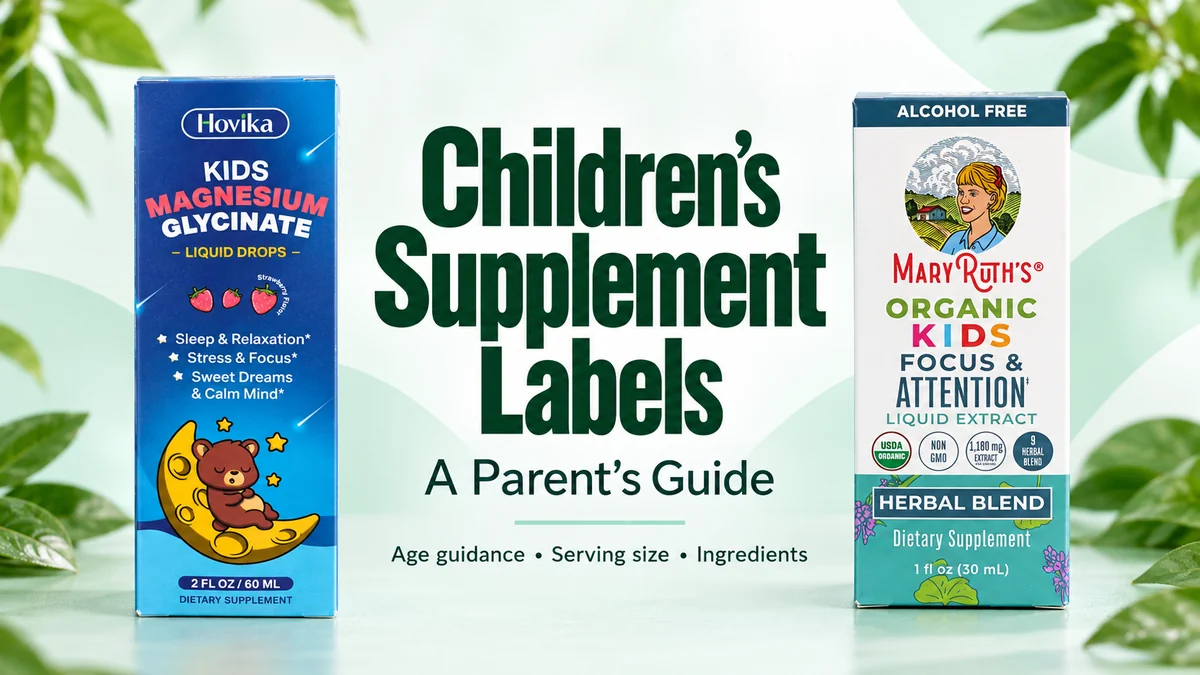
Reading children’s supplement labels starts with a few practical questions: which age group is shown, what counts as one serving, which ingredients are included, and what information is missing? A colourful bottle or a “calm” or “focus” claim cannot answer all of them. This parent’s guide uses four products from Be Healthy BD’s children’s range to explain how to check liquid drops, gummies and herbal blends before discussing a supplement with your child’s healthcare professional.
Start here
Read the age guidance, serving size, amounts, full ingredient list and warnings together. A label serving is a reference for the figures on the pack; it does not establish what your child needs. The examples below explain labels, rather than rank products or recommend a daily dose.
First ask whether a supplement is needed
Most healthy children eating a varied diet do not need extra vitamin or mineral supplements, according to the American Academy of Pediatrics’ parent guidance. A restricted diet, a diagnosed deficiency or another individual health need may change that assessment. A paediatrician or dietitian can help decide whether supplementation is useful.
If the concern is ongoing sleep difficulty, attention, behaviour or school performance, start with an assessment of the concern. Choosing a bottle because its name mentions “focus” does not identify the cause. The NCCIH guidance for children advises against delaying established care or replacing prescribed medicines with unproven approaches.
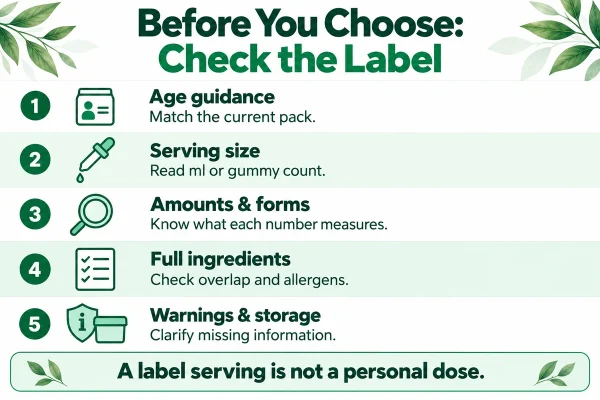
Five checks for children’s supplement labels
- Match the product and age guidance. Check the exact name, pack size, formula and age range on the current bottle or box. Similar names can cover different products. An age marking alone does not establish suitability for an individual child.
- Find the serving size. Look for the stated number of gummies or volume in millilitres. Keep this separate from directions about how often the product is used.
- Read the amount and ingredient form together. Identify what the number measures, its unit, and whether it applies to one serving or more.
- Read the whole formula. Check added vitamins, minerals, herbs, sweeteners and other ingredients, including anything relevant to an allergy.
- Find warnings and unresolved details. Check medicine cautions, storage, expiry and measuring instructions. Ask for clarification when a panel is missing, unreadable or inconsistent.
The FDA’s explanation of US supplement labels describes serving sizes, amounts per serving and the separate “Other Ingredients” list. These are useful reading tools for imported US-style packs; they are not a statement that a product has been approved in Bangladesh.
Serving size, concentration and directions are different
A 60 ml bottle tells you the total liquid volume. It does not tell you how much magnesium is in each millilitre. Likewise, “30 gummies” tells you the pack count, not the nutrient amount per gummy.
For liquids, read the marked millilitre volume. Do not assume that a “drop,” a full dropper and 1 ml are interchangeable. If the supplied device has no clear markings, ask a pharmacist about an appropriate measuring device rather than estimating. Follow the current pack’s handling instructions if a clinician has advised use.
What does “magnesium as glycinate” mean?
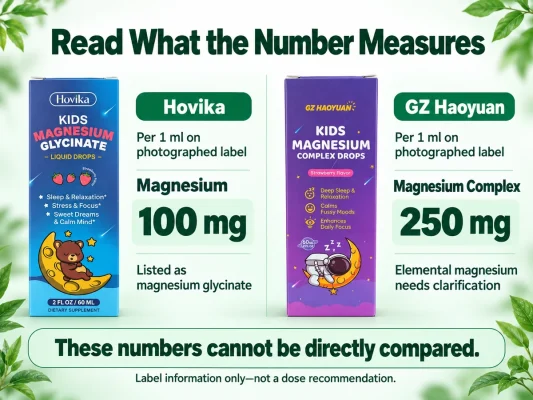
The NIH magnesium fact sheet explains that a Supplement Facts magnesium amount represents elemental magnesium, rather than the weight of the whole magnesium compound. The words in brackets identify its source. However, a panel that instead lists a “Magnesium Complex” weight needs clarification: do not automatically treat the entire complex weight as elemental magnesium. The GZ example below explains this distinction.
For more background on the form names, see our magnesium glycinate vs citrate guide. Its general comparison should not be used to choose a child’s dose.
Four worked examples: what the labels tell us
These examples come from Be Healthy BD’s product range. Inclusion is not an endorsement for every child. The figures below were checked against photographs of the physical packs supplied for this guide. These photographs supersede earlier online graphics where the formulas differ. Label claims have not been independently tested, and unresolved wording is identified rather than guessed.
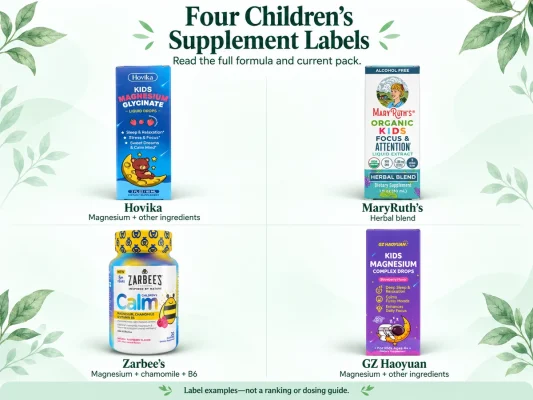
| Product | Label-reading example | Important limit |
|---|---|---|
| Hovika Kids Magnesium Glycinate Drops — 60 ml | Photographed box: magnesium 100 mg per 1 ml; 200 mg per 2 ml. Also lists L-theanine, calcium, ALA omega-3, vitamins and zinc. | Age bands still overlap at eight. Directions and caution panel are now available, but do not resolve that boundary. |
| MaryRuth’s Kids Focus & Attention — 30 ml | Photographed box: nine-herb proprietary blend extract, 1.18 g (1,180 mg) per 1 ml; about 30 label servings. Directions say ages 4+. | The total is for the whole blend; individual herb amounts are not declared. Earlier ten-herb imagery does not match this pack. |
| Zarbee’s Children’s Calm — 30 gummies | One gummy: magnesium 25 mg, chamomile 50 mg, vitamin B6 0.6 mg. The panel also shows two-gummy amounts. | Pack says ages 5+ and occasional use only. Includes added sugars, allergy and drowsiness cautions. |
| GZ Haoyuan Kids Magnesium Complex Drops — 60 ml | Photographed box: “Magnesium Complex” 250 mg per 1 ml; 500 mg per 2 ml, with four named forms. Also includes vitamins, potassium, herbs and L-theanine. | Elemental magnesium is not clearly identified. Age columns overlap at twelve; earlier two-form graphics do not match this pack. |
Hovika: read the smaller ingredient lines too
Hovika’s photographed 1 ml column lists magnesium 100 mg, calcium 50 mg, L-theanine 50 mg, ALA omega-3 50 mg, vitamin C 20 mg, vitamin B6 2 mg, vitamin D3 25 mcg (1,000 IU) and zinc 2 mg. Its 2 ml column doubles these declared amounts. The product therefore needs to be considered alongside any other vitamin D, B6 or mineral supplement the child already uses.
The panel identifies the omega-3 as alpha-linolenic acid from chia seed oil. ALA is distinct from EPA and DHA, as explained in the NIH omega-3 fact sheet. Do not treat the stated ALA amount as the same amount of fish-oil EPA or DHA.
The physical box shows vitamin D3 as 25 mcg (1,000 IU), 125% Daily Value per 1 ml, and 50 mcg (2,000 IU), 250% per 2 ml. These percentages differ from the earlier promotional graphic. Use the current pack when comparing labels; a Daily Value is a labelling reference, not an individual prescription.
Its directions say to shake well and describe one or two full droppers as 1 ml or 2 ml per day, or as directed by a physician. The caution panel says not to exceed the suggested amount, to consult a physician for a known medical condition, to keep the product out of children’s reach and to store it in a cool, dry place. These are manufacturer directions, not a recommendation for a particular child.
Hovika’s age-eight ambiguity needs clarification
The photographed box places 1 ml under “4–8 years” and 2 ml under “8+ years.” Both include an eight-year-old. Do not choose the larger amount from that overlap. The NIH reference lists a magnesium upper limit of 110 mg/day from supplements and medicines for ages 4–8; Hovika’s 2 ml column declares 200 mg. Clarify the current label with the supplier or manufacturer and the child’s clinician before use.
This upper limit excludes magnesium naturally present in foods and drinks. It is not a recommended dose or a guarantee of suitability below the limit; clinician-supervised treatment may differ.
MaryRuth’s: a blend total is not an amount for each herb
The photographed MaryRuth’s box identifies a nine-herb blend, matching the version currently described on the manufacturer’s website. Its Supplement Facts panel lists a 1 ml serving and 1.18 g (1,180 mg) organic proprietary blend extract, with about 30 servings per container.
The listed herbs are astragalus root, wood betony aerial parts, ginkgo leaf, eleuthero root, rhodiola root, licorice root, English lavender flower, spearmint leaf and passionflower aerial parts. Gotu kola, shown in an earlier supplied ten-herb graphic, is not listed on this box. Do not mix photographs or ingredient lists from those different versions.
A proprietary blend may state a total without disclosing each herb’s quantity; the FDA label guidance explains this exception. The 1,180 mg figure belongs to the whole extract blend. It cannot be divided equally among nine herbs or treated as the amount of any single herb.
The pack’s directions are for ages 4+ and warn against direct dropper contact with skin or mouth. Its cautions advise professional review, particularly with medicines or a medical diagnosis, and stopping use for a negative reaction. It says to store in a cool, dry place, with no refrigeration necessary. The name “Focus & Attention” does not establish treatment effectiveness for an attention disorder.
Zarbee’s: compare one gummy with one gummy
The Zarbee’s manufacturer page and Supplement Facts panel show magnesium citrate, German chamomile flower extract and vitamin B6. One gummy provides 25 mg magnesium, 50 mg chamomile and 0.6 mg B6; two provide 50 mg, 100 mg and 1.2 mg respectively. Added sugars are 2 g per gummy and 4 g per two gummies.
The photographed bottle’s serving suggestions distinguish ages 5–9 from ages 10–12, allowing one to two gummies for the latter group. A two-gummy panel column should not be read as a requirement for every older child. The comparison here uses the declared amounts, not a recommendation to give a particular serving.
Read the use cautions too: this bottle says “for occasional use only.” It warns about allergies to its ingredients and the Asteraceae family, including ragweed, and says chamomile may cause drowsiness, which can increase when combined with other ingredients that cause drowsiness. It also advises speaking with a doctor for unusual or persistent restlessness. A general manufacturer webpage should not override the specific warnings on the pack received.
GZ Haoyuan: clarify what “Magnesium Complex” measures
The photographed GZ box has a different formula from the earlier supplied graphic. Per 1 ml, it lists 250 mg “Magnesium Complex”, described as 40% magnesium glycinate, 20% magnesium malate, 20% magnesium citrate and 20% magnesium taurate. The 2 ml column lists 500 mg complex. Those percentages describe the named complex; they do not establish an elemental-magnesium amount.
Do not compare 250 mg complex directly with Hovika’s 100 mg magnesium. The GZ panel does not clearly say whether the complex figure represents compound weight or elemental magnesium. Ask the manufacturer to state the elemental magnesium per 1 ml before making that comparison or adding it to other magnesium products. Do not calculate it from the form percentages.
The same 1 ml column lists vitamin D3 10 mcg, vitamin B6 0.4 mg, vitamin B12 0.5 mcg, potassium 49 mg, lemon balm leaf extract 20 mg, ashwagandha 10 mg, L-theanine 10 mg, spinach leaf 10 mg and black pepper extract (10:1) 3 mg. Chamomile is not listed on this photographed pack.
The panel headings read ages 4–12 for 1 ml and 12+ for 2 ml, so both include a twelve-year-old. Its separate directions describe one or two full droppers as 1 ml or 2 ml per day, or physician guidance, without resolving that boundary. The caution panel says not to exceed the suggested amount, to seek physician advice for a known medical condition, and to store in a cool, dry place. Clarify the ambiguous age boundary and magnesium declaration rather than selecting a serving from them.
Check for overlapping ingredients before combining products
Place every supplement and medicine label together, including multivitamins and products marketed for sleep, immunity or focus. Record the amount used, its frequency and repeated ingredients. A different brand name does not mean a different nutrient.
Look beyond the magnesium name: Hovika and the photographed GZ formula both list vitamin D3, B6 and L-theanine. Their amounts differ, and GZ’s elemental-magnesium contribution remains unclear. Repeated ingredients still matter, even when a reliable combined magnesium total cannot be calculated.
Ask a pharmacist or paediatrician to review the complete list. Record unknown quantities as unknown rather than zero. Include separate vitamin D drops, multivitamins and any herbal products in the review. Neither the number of ingredients nor the format establishes a better fit.
Claims, allergies and medicines: what a front label cannot settle
Words such as “natural,” “organic,” “calm” and “focus” do not establish that a product is necessary or suitable for your child. NCCIH notes that many supplements have not been tested in children and that products sold online may differ from those studied in research. An ingredient study cannot automatically validate a different multi-ingredient product.
- Chamomile: it appears in the photographed Zarbee’s formula. NCCIH reports possible allergic reactions, especially in people sensitive to related plants such as ragweed, and potential medicine interactions. “Herbal” does not mean allergy-free.
- Licorice and other herbs: MaryRuth’s photographed ingredient panel includes licorice. NCCIH describes risks from licorice’s glycyrrhizin component and interactions with medicines. The available pack information does not establish its glycyrrhizin content; ask a clinician to review the formula rather than estimating it.
- Ashwagandha: it appears in the photographed GZ formula. NCCIH describes potential drowsiness, medicine interactions and rare liver injury reports. These general findings do not establish the safety or effectiveness of this children’s mixture; have the exact formula reviewed professionally.
- Magnesium: supplemental magnesium can cause digestive side effects, and kidney problems increase toxicity risk. It can also interact with some antibiotics; see the NIH safety and interactions guidance. Ask a pharmacist about the actual medicines involved.
Keep the child’s care plan central
Discuss supplements with a qualified healthcare professional, particularly when a child has a medical condition, takes medicines or has persistent symptoms. Stop use and seek medical advice for a concerning reaction. Store drops and gummies out of children’s sight and reach; gummies should not be offered as sweets. This is general label-reading education, not a diagnosis, treatment plan or personalised dose.
A practical checklist before buying in Bangladesh
Ask for readable photographs of the actual pack’s front, Supplement Facts, directions and warnings. Compare the product name, size and ingredient list across those photographs. A manufacturer’s updated website can be useful, but it may describe a different version from the stock being supplied.
- Check the seal, lot or batch identification and expiry date on the pack received.
- Read storage instructions, including any requirements after opening. Do not invent a refrigeration rule or use-within period when one is missing.
- Check allergens, sweeteners and any dietary certification that matters to your family; a front-label claim does not replace the ingredient list.
- Keep a photograph of the exact label with the child’s supplement and medicine list for professional review.
Browse Be Healthy BD’s children’s support category for product details and current availability. Use the checklist above to identify questions before choosing a product.
Frequently asked questions
Is magnesium glycinate suitable for every child?
No. The form name alone cannot establish need or suitability. The child’s age, health, medicines, full formula and total supplemental intake all matter. Have a paediatrician or pharmacist review the exact product and label.
Is one full dropper always 1 ml?
Do not assume it is. Check the volume markings and product instructions. A drop count or a full dropper should not be substituted for a stated millilitre amount without confirmation.
Can magnesium drops and a focus supplement be used together?
Do not combine them simply because their names describe different benefits. Review both ingredient lists, repeated nutrients or herbs, medicines and any missing quantities with the child’s healthcare professional.
Does “Focus & Attention” mean a supplement treats ADHD?
No. A product name or support claim does not establish treatment effectiveness. Persistent attention concerns deserve professional assessment, and supplements should not replace an established care plan.
Are liquid drops better than gummies?
The format alone does not establish better results. Liquids require accurate measurement; gummies require attention to the number per serving, added ingredients and safe storage. Compare the full formula and the child’s needs.
What if the website and bottle show different formulas?
Ask the supplier to confirm the exact version and provide its complete label. Do not combine the front image from one version with Supplement Facts from another. Keep uncertain amounts unverified until the matching information is available.
Sources and how this guide was checked
Product quantities and warnings were checked against photographs of the physical packs on 15 October 2026. Earlier online graphics were superseded where they differed. Health and label-reading explanations use the linked NIH, NCCIH, FDA and American Academy of Pediatrics resources, reviewed in October 2026. Manufacturer information establishes label claims, not independent clinical effectiveness.
The photographed Hovika age bands overlap at eight; GZ’s overlap at twelve, and its elemental-magnesium amount needs clarification. No missing values were estimated. Reading a pack does not independently verify contents, purity, authenticity or clinical benefit. Recheck the actual pack when stock or packaging changes.