
How to Compare Glutathione Supplements and Read Their Labels
Sep
Reviewed against the product labels and published research in August 2026
Glutathione supplement labels can be surprisingly difficult to compare. A bottle may highlight 1,000 mg, 1,750 mg or 2,400 mg on the front, but that number may describe glutathione alone, a liposomal blend or the total weight of several combined ingredients. If you are shopping for glutathione supplements in Bangladesh, the safest comparison starts with the Supplement Facts panel—not the biggest number on the front. Check the serving size, the specifically declared glutathione amount, the form, added ingredients and number of servings in the bottle.
Quick answer
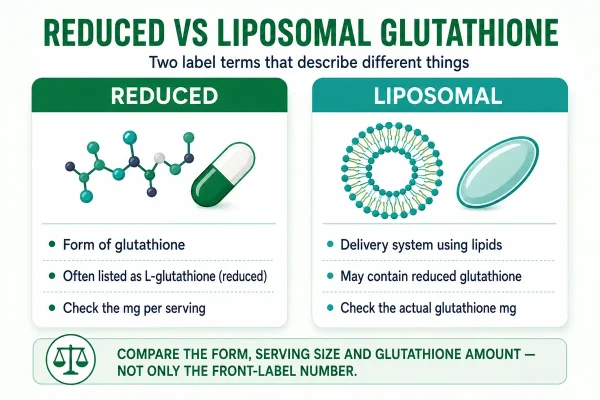
Reduced glutathione identifies the GSH form of the molecule. Liposomal glutathione describes a delivery approach in which glutathione is combined with phospholipids. These terms answer different questions, so one does not automatically make a product better. Compare the amount of glutathione actually declared per serving, the number of capsules or softgels in that serving and whether the large front-label number includes phospholipids, vitamin C, amino acids or other ingredients.
What is glutathione?
Glutathione is a tripeptide made from three amino acids: cysteine, glutamate and glycine. The body produces it naturally, and it participates in antioxidant defence and cellular redox processes. On supplement labels, it may appear as glutathione, L-glutathione, reduced glutathione or GSH.
A dietary supplement is not the same as a medicine, and a label does not prove that the product will produce a particular cosmetic or health result. Human studies have examined oral glutathione at different doses, durations and formulations, but their findings are not fully consistent. That is why this guide focuses first on what shoppers can verify directly: the form, serving size and amount declared on the label.
Reduced glutathione vs liposomal glutathione
What does “reduced glutathione” mean?
Reduced glutathione is commonly written as GSH. “Reduced” describes its chemical state; it does not mean that the amount or quality has been reduced. Products may list a straightforward amount such as 500 mg of reduced glutathione, or include reduced glutathione inside a larger blend.
What does “liposomal glutathione” mean?
“Liposomal” usually means the formula uses phospholipids—fat-like molecules intended to carry or surround the ingredient. A small human pilot study reported increased glutathione measures after one month of liposomal glutathione, but it included only 12 adults and did not compare every commercial liposomal product with standard reduced glutathione. Therefore, the word “liposomal” is useful formulation information, not proof that every liposomal capsule or softgel is absorbed equally or guarantees better results.
Important distinction: A product can be both reduced and liposomal. “Reduced” describes the glutathione form, while “liposomal” describes the delivery system. Check the Supplement Facts panel to see how much reduced glutathione and how much phospholipid or blend weight are actually declared.
| Label term | What it tells you | What it does not prove |
|---|---|---|
| Reduced glutathione / GSH | The chemical form of glutathione listed in the formula | A guaranteed cosmetic result, ideal dose or superior product quality |
| Liposomal glutathione | Glutathione is combined with a phospholipid-based delivery system | That all “liposomal” products use the same technology or have equal absorption |
| Proprietary blend | The total weight of the combined ingredients in that blend | The exact amount of each ingredient unless the label separately discloses it |
| Per serving | The amount supplied by the serving shown at the top of the facts panel | That the amount comes from one capsule; a serving may require two or more |
Why 1,750 mg or 2,400 mg may not mean that much glutathione
The number on the front of a bottle may refer to one of three different things:
- the amount of glutathione itself;
- the total weight of a glutathione-and-phospholipid blend; or
- the combined weight of glutathione, vitamins, amino acids and botanical ingredients.
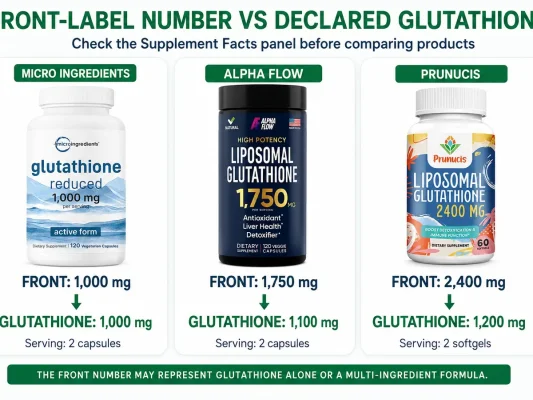
For example, the Micro Ingredients label declares 1,000 mg of reduced glutathione per two-capsule serving, so its highlighted number matches the glutathione amount. The Alpha Flow front label highlights 1,750 mg per serving, while its Supplement Facts panel breaks this into a 1,500 mg liposomal blend containing 1,100 mg reduced glutathione and 400 mg phospholipid complex, plus a 250 mg enhancement blend. The Prunucis 2,400 mg figure is also the total of several blends; its label identifies 1,200 mg of reduced glutathione in the two-softgel serving.
The simple label rule
First find Serving Size. Then locate the specifically declared amount of glutathione or reduced glutathione. If glutathione appears only inside a proprietary blend without an individual amount, do not assume the entire blend weight is glutathione.
Six glutathione supplement labels compared
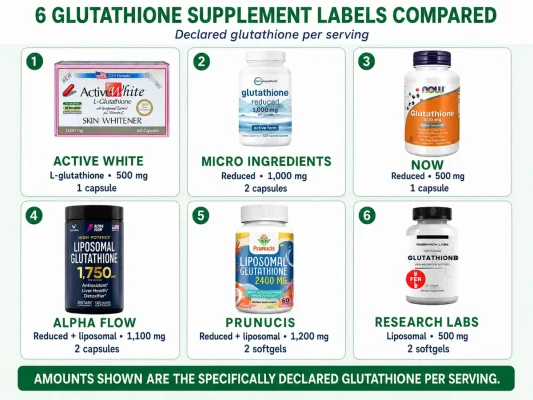
The comparison below is based on the visible product labels and manufacturer information available in August 2026. It is not a ranking, a promise of results or a personal dosage recommendation. Manufacturers can update labels, so check the bottle you receive before use.
| Product | Label serving | Glutathione declared | Useful label detail |
|---|---|---|---|
| Active White L-Glutathione 1,000 mg – 60 capsules | 1 capsule | 500 mg L-glutathione | The 1,000 mg formula also contains 250 mg vitamin C and 250 mg grape-seed extract. |
| Micro Ingredients Glutathione Reduced 1,000 mg – 120 vegetarian capsules | 2 capsules | 1,000 mg reduced glutathione | The highlighted amount matches the reduced-glutathione amount per serving; the bottle provides 60 servings. |
| NOW Glutathione 500 mg – 60 veg capsules | 1 capsule | 500 mg reduced glutathione | Each serving also provides 100 mg milk-thistle extract and 50 mg alpha-lipoic acid. |
| Alpha Flow Liposomal Glutathione 1,750 mg – 120 capsules | 2 capsules | 1,100 mg reduced glutathione | The 1,750 mg total includes 400 mg phospholipid complex, 150 mg vitamin C and 100 mg alpha-lipoic acid. |
| Prunucis Liposomal Glutathione 2,400 mg – 60 softgels | 2 softgels | 1,200 mg reduced glutathione | The total also includes phosphatidylcholine, a precursor blend, vitamin C, milk thistle, alpha-lipoic acid and TMG. The softgel contains gelatin. |
| Research Labs Liposomal Glutathione – 60 softgels | 2 softgels | 500 mg liposomal glutathione | The bottle provides 30 label servings. Compare the declared 500 mg—not promotional absorption language—with other products. |
Want to view more formats? Browse our collagen and glutathione supplements available in Bangladesh. Check current availability, the latest product label, expiry information and serving instructions before ordering.
Capsules, softgels and serving size: what changes?
Vegetarian capsules
Vegetarian capsules are commonly made with cellulose-based shells. They may suit shoppers who avoid gelatin, but “vegetarian capsule” does not by itself tell you the glutathione form, dose or quality. In this comparison, serving sizes range from one to two capsules.
Softgels
Softgels can hold oil-based or phospholipid-containing formulas, which is why they are often used for products marketed as liposomal. Traditional softgels commonly contain gelatin, so shoppers with dietary or religious requirements should check the other-ingredients list rather than relying only on the front label.
Liquids and powders
Liquid and powder products require a different type of comparison. Check the number of millilitres, drops or scoops in one serving, whether a measuring device is supplied and how the product must be stored after opening. Do not compare “mg per bottle” with “mg per serving.”
Servings per bottle
A 120-capsule bottle may provide 120 servings when one capsule is used, or 60 servings when the label serving is two capsules. Similarly, a 60-softgel bottle with a two-softgel serving provides 30 servings. For a useful taka-for-taka comparison, divide the current bottle price by the number of servings—not simply by the capsule count.
What does the research say about oral glutathione?
The evidence is mixed rather than uniformly positive or negative. A four-week randomized trial using 500 mg twice daily did not find significant changes in glutathione status or measured oxidative-stress biomarkers in healthy adults. A separate six-month randomized trial using 250 mg or 1,000 mg daily reported increased glutathione stores in several body compartments. These different findings show why duration, formulation, population and the measured outcome matter.
Research on liposomal glutathione is promising but limited. The frequently cited one-month pilot involved 12 healthy adults and did not provide a large head-to-head comparison of commercial liposomal and non-liposomal products. It is therefore reasonable to recognise liposomal delivery as a formulation difference, but not to assume that a large marketing claim proves superior absorption for a particular bottle.
Evidence for skin-colour changes is also uncertain. One small randomized trial found statistically significant changes at only some measured sites after four weeks, and its authors stated that long-term safety required more study. A later systematic review concluded that the overall evidence remained inconclusive because of study quality and inconsistent findings. A responsible product comparison should therefore avoid promises such as permanent whitening, guaranteed removal of dark spots or a fixed number of shades of change.
Practical evidence point: A study showing a change in a blood marker does not automatically prove a visible cosmetic outcome or treatment benefit. Likewise, a result from one researched formulation cannot be applied automatically to every product using similar words on its front label.
How to compare a glutathione supplement more confidently
1. Start with the serving size
Look at the top of the Supplement Facts panel. If the serving is two capsules, every amount in the panel normally refers to those two capsules—not one.
2. Find the specifically declared glutathione amount
Do not assume that a “2,400 mg complex” contains 2,400 mg of glutathione. Look for the indented ingredients and their individual amounts. If a proprietary blend does not disclose the glutathione amount separately, the label does not provide enough information for an exact milligram comparison.
3. Separate the form from the dose
Reduced, liposomal, capsule and softgel describe different features. Compare them separately: chemical form, delivery system, dosage form and amount per serving.
4. Review added ingredients
Vitamin C, alpha-lipoic acid, milk thistle, grape-seed extract, phospholipids and amino-acid precursors can change the purpose and suitability of a formula. Added ingredients are not automatically an advantage; they may also introduce allergy, medicine-interaction or dietary considerations.
5. Compare servings and current value
Use current price per label serving, then consider the specifically declared glutathione amount and added ingredients. Prices change, so keeping price figures out of an educational article prevents the comparison from becoming outdated.
6. Check authenticity and storage
For imported supplements in Bangladesh, examine the safety seal, batch or lot number, expiry date and condition of the bottle when it arrives. Follow the label’s storage instructions and keep the product away from direct sunlight, high heat and bathroom humidity. Do not use a product if its seal is broken or the contents appear damaged.
Safety note
This article is for general education and does not diagnose, treat or replace medical advice. Do not use glutathione supplements as a substitute for assessment or treatment of melasma, post-inflammatory pigmentation, liver disease or another health condition.
Ask a doctor or pharmacist before use if you are pregnant or breastfeeding, choosing a product for a child, taking regular medicines, receiving cancer treatment or managing a medical condition. Multi-ingredient products require review of every active ingredient—not only glutathione. Stop using a supplement and seek medical advice if you develop a concerning reaction.
This guide concerns oral dietary supplements. Intravenous glutathione is a different route with additional safety concerns and should not be treated as equivalent to capsules, softgels or liquids.
Frequently asked questions
What does reduced glutathione mean?
Reduced glutathione is the GSH form of the molecule. The word “reduced” refers to its chemical state; it does not mean lower strength. Check the number beside it in the Supplement Facts panel to find the amount per serving.
Is liposomal glutathione always better absorbed?
Not necessarily. A small human pilot study reported increased glutathione measures with one liposomal preparation, but commercial products can use different formulations. There is not enough head-to-head evidence to conclude that every product labelled “liposomal” outperforms every standard reduced-glutathione product.
Does 1,000 mg on the front always mean 1,000 mg of glutathione?
No. It may represent glutathione alone or the total weight of a multi-ingredient formula. For example, the Active White 1,000 mg formula declares 500 mg L-glutathione plus vitamin C and grape-seed extract, while the Micro Ingredients label declares 1,000 mg reduced glutathione per serving.
Is the amount listed per capsule?
Only when the serving size is one capsule. Many products use a two-capsule or two-softgel serving. Always read the serving-size line before comparing amounts.
Can oral glutathione permanently whiten skin?
Current evidence does not support a promise of permanent whitening or a guaranteed cosmetic result. Trials have been relatively small and inconsistent, with effects reported at some measured skin sites but not others. Speak with a dermatologist about pigmentation concerns and realistic treatment options.
How should I compare the price of two products?
Divide the current bottle price by the number of label servings. Then compare the specifically declared glutathione amount, form and added ingredients per serving. Price per capsule can be misleading when serving sizes differ.
Final takeaway
When comparing a glutathione supplement in Bangladesh, begin with the back label. Reduced and liposomal describe different formulation features, while the largest front-label number may include several ingredients. The most useful comparison uses the serving size, specifically declared glutathione amount, added ingredients, number of servings, dietary suitability and current product condition. Evidence for oral glutathione varies by formulation and outcome, so avoid guaranteed-result claims and seek professional guidance when health conditions or medicines are involved.
Sources and further reading
- US Food and Drug Administration: Dietary Supplement Labeling Guide
- Allen and Bradley: Four-week randomized trial of oral glutathione
- Richie and colleagues: Six-month randomized trial of oral glutathione
- Sinha and colleagues: Pilot study of oral liposomal glutathione
- Arjinpathana and Asawanonda: Randomized trial examining skin melanin indices
- Dilokthornsakul and colleagues: Systematic review of glutathione and skin outcomes