
Fish Oil vs Cod Liver Oil: What Is the Difference?
Sep
Product-label images and health information checked in September 2026
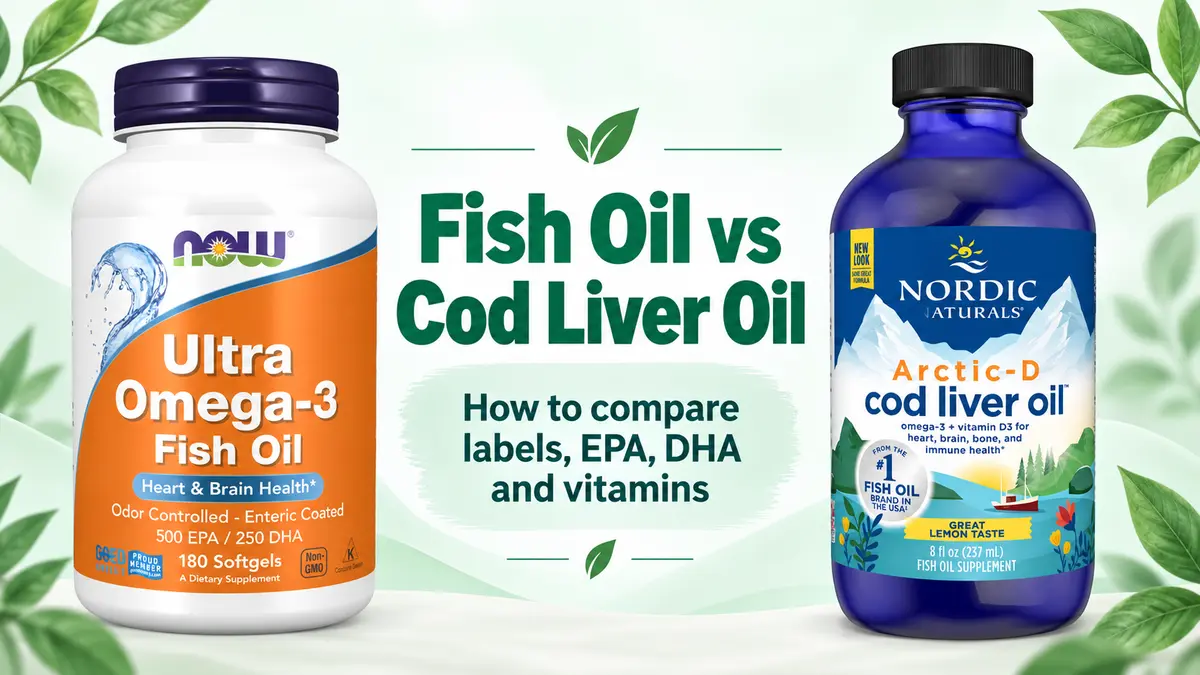
Comparing fish oil vs cod liver oil starts with three things: EPA and DHA, vitamins A and D, and the serving size. Both oils can provide omega-3 fatty acids, but their nutrient amounts vary. A larger number on the front does not necessarily mean more EPA and DHA. For shoppers in Bangladesh, this guide explains the differences using six product labels, including softgels and liquid cod liver oils.
Quick answer
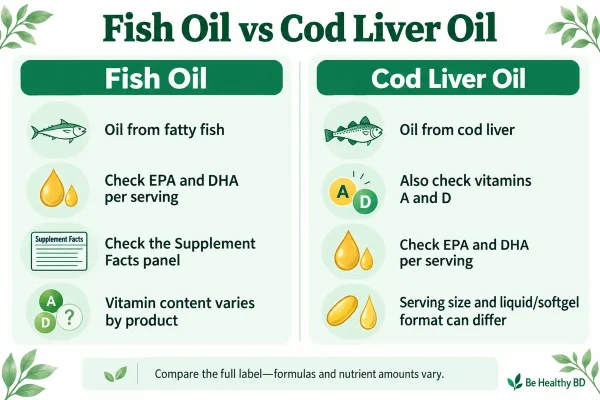
Fish oil is usually compared for its EPA and DHA content. Cod liver oil comes from cod livers and can also supply vitamins A and D. Neither is automatically better for everyone. Compare the amounts per label serving, check any vitamin overlap with your other supplements, and choose a format you can measure and store correctly.
Fish oil vs cod liver oil: the key differences
Conventional fish oil is obtained from fish body oils, while cod liver oil is obtained from the liver of cod. Cod liver oil is therefore a fish-derived oil, but shops commonly list it separately because its vitamin content adds another consideration.
The US National Center for Complementary and Integrative Health explains that fish liver oils contain EPA, DHA and varying amounts of vitamins A and D. These vitamins can be harmful in excess, so their presence is something to assess, rather than an automatic reason to prefer cod liver oil.
| What to compare | Fish oil | Cod liver oil |
|---|---|---|
| Source | Fish body oils, often from species such as anchovies and sardines | Cod liver |
| Omega-3 content | Look for EPA and DHA amounts; concentrations vary | Can provide EPA and DHA, but some labels do not declare their amounts |
| Vitamins A and D | Do not assume the product supplies them; check the formula | Amounts vary, and some products include added vitamins |
| Format in this guide | Softgels | Softgels and measured liquids |
| Main label question | How much EPA and DHA does the serving provide? | How much EPA, DHA, vitamin A and vitamin D does the serving provide? |
What are EPA and DHA?
EPA stands for eicosapentaenoic acid, and DHA stands for docosahexaenoic acid. They are two omega-3 fatty acids found in fish and seafood. Another omega-3, ALA, occurs mainly in plant foods and oils. The body converts only small amounts of ALA into EPA and DHA. The NIH omega-3 consumer fact sheet explains these differences.
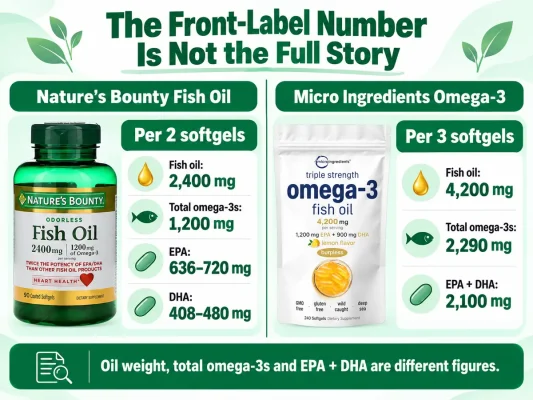
For label comparison, keep three figures separate: the weight of fish oil, the total omega-3 amount, and the EPA plus DHA amount. Total omega-3s may include other omega-3 fatty acids besides EPA and DHA.
Why 2,400 mg of fish oil does not mean 2,400 mg of omega-3
Start at Serving Size on the Supplement Facts panel. The amounts beneath it apply to that serving, which might be one, two or three softgels. The FDA supplement-labeling guide distinguishes serving size, amounts per serving and servings per container.
Nature’s Bounty: fish oil and total omega-3s are different figures
The supplied Nature’s Bounty label lists 2,400 mg fish oil per two softgels, providing 1,200 mg total omega-3 fatty acids. Within that total, EPA is listed as 636–720 mg and DHA as 408–480 mg. Those are the ranges shown on this label, so they should not be replaced with a single assumed figure.
Micro Ingredients: separate all three numbers
The Micro Ingredients panel uses a three-softgel serving. It lists 4,200 mg fish oil, including 2,290 mg total omega-3s. The breakdown is 1,200 mg EPA, 900 mg DHA and 190 mg other omega-3s. EPA plus DHA therefore equals 2,100 mg per serving.
Dividing the EPA and DHA figures by three gives a calculated 400 mg EPA and 300 mg DHA per softgel. By comparison, NOW Ultra declares 500 mg EPA and 250 mg DHA in its one-softgel serving. This arithmetic helps explain the labels; it does not establish which dose someone should take.
The simple label rule
Read serving size → oil amount → total omega-3s → EPA and DHA. For cod liver oil, also check vitamins A and D. Keep a missing amount marked as “not declared”; a missing number does not mean zero.
Six fish oil and cod liver oil labels compared
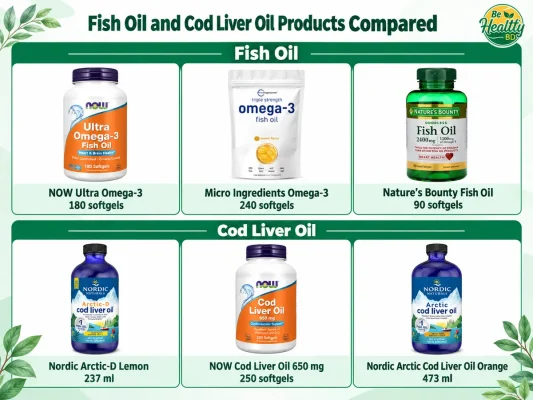
These figures come from the product-label images supplied for this guide. All amounts below are per label serving. Packaging and formulas can change, so check the current pack before use. This table compares label information and is not a product ranking or a dosage recommendation.
| Product | Label serving | EPA and DHA | Other useful label information |
|---|---|---|---|
| NOW Ultra Omega-3 Fish Oil – 180 softgels | 1 softgel | EPA: 500 mg DHA: 250 mg Combined: 750 mg |
1,000 mg fish oil concentrate. The panel lists EPA and DHA without a separate total omega-3 figure. Front label states enteric coated. |
| Micro Ingredients Omega-3 Fish Oil, Lemon – 240 softgels | 3 softgels | EPA: 1,200 mg DHA: 900 mg Combined: 2,100 mg |
4,200 mg fish oil; 2,290 mg total omega-3s, including 190 mg other omega-3s. 80 label servings per pack. |
| Nature’s Bounty Fish Oil 2,400 mg Odorless – 90 softgels | 2 softgels | EPA: 636–720 mg DHA: 408–480 mg |
2,400 mg fish oil; 1,200 mg total omega-3s. This label declares EPA and DHA as ranges. 45 label servings per bottle. |
| Nordic Naturals Arctic-D Cod Liver Oil, Lemon – 237 ml | 1 teaspoon (approximately 5 ml) |
EPA: 340 mg DHA: 510 mg Combined: 850 mg |
1,060 mg total omega-3s. Vitamin D3: 25 mcg (1,000 IU). Label also notes naturally occurring vitamin A. |
| NOW Cod Liver Oil 650 mg – 250 softgels | 1 softgel | EPA: not declared DHA: not declared |
650 mg cod liver oil. Vitamin A: 750 mcg; vitamin D: 6.75 mcg (270 IU). Total omega-3s are not declared. |
| Nordic Naturals Arctic Cod Liver Oil, Orange – 473 ml | 1 teaspoon (approximately 5 ml) |
EPA: 340 mg DHA: 510 mg Combined: 850 mg |
1,060 mg total omega-3s. Label notes naturally occurring vitamins A and D; it does not declare the 1,000 IU D3 amount shown on Arctic-D. |
A useful limit to this comparison: The 650 mg on NOW Cod Liver Oil is the oil weight. Its supplied panel gives no EPA or DHA quantities, so an exact EPA/DHA comparison is unavailable. Do not estimate these figures from another brand or a generic cod liver oil value.
Explore our fish oil and other oil supplements in Bangladesh to check current availability, pack sizes and product-label images.
Cod liver oil: check vitamins A and D separately
The two Nordic liquids show why similar-looking products should be compared carefully. Both labels declare 340 mg EPA and 510 mg DHA per approximately 5 ml, but Arctic-D includes a declared 25 mcg of vitamin D3. The Orange product’s footnote describes a much smaller naturally occurring vitamin D contribution.
| Cod liver oil | Label serving | Vitamin A | Vitamin D |
|---|---|---|---|
| Nordic Arctic-D, Lemon | Approximately 5 ml | Footnote: up to 30% of the Daily Value; no exact mcg amount stated | 25 mcg (1,000 IU) vitamin D3 |
| NOW Cod Liver Oil 650 mg | 1 softgel | 750 mcg, from retinyl palmitate and cod liver oil | 6.75 mcg (270 IU), from D3 cholecalciferol and cod liver oil |
| Nordic Arctic, Orange | Approximately 5 ml | Footnote: up to 30% of the Daily Value; no exact mcg amount stated | Footnote: less than 2% of the Daily Value; no exact mcg amount stated |
“Up to” is a limit, not an exact amount. The Nordic vitamin footnotes should not be converted into fixed nutrient quantities. A label’s Daily Value is also a reference for labeling, not your personal daily requirement.
Vitamin D may be written in micrograms (mcg) or international units (IU). For vitamin D, 1 mcg equals 40 IU: 25 mcg is therefore 1,000 IU, and 6.75 mcg is 270 IU. This conversion is explained in the NIH vitamin D fact sheet. Do not apply the same conversion to other vitamins.
If you also take a multivitamin, vitamin D or a calcium-and-vitamin-D product, include those amounts when reviewing your total intake. Cod liver oil is not automatically a suitable substitute for a prescribed vitamin D product. The NIH vitamin A guidance also explains why excessive preformed vitamin A, including retinol and retinyl esters, can be harmful.
Softgels, liquids and servings per pack
Softgels: count the serving, not just the capsules
A 240-softgel pack with a three-softgel serving provides 80 label servings. A 90-softgel bottle with a two-softgel serving provides 45. These counts help you compare value, but they are not necessarily the number of days a pack will last.
For example, the supplied Nature’s Bounty panel uses two softgels per serving, while its separate directions describe that serving twice daily. The table reports one label serving only. Check both the serving-size line and the directions on your current bottle, and discuss an appropriate regimen with your doctor or pharmacist.
Liquids: measure the volume
Both Nordic panels use one teaspoon, approximately 5 ml. Use a suitable measuring spoon or device instead of assuming every household teaspoon holds the same volume. A larger bottle gives more liquid; it does not establish a higher nutrient concentration per serving.
Ingredients and storage matter too
The four softgel products in this guide list gelatin. Both NOW labels specifically identify bovine gelatin. If you have halal or other dietary requirements, check the complete ingredient list and relevant certification; “fish oil” does not tell you the source or certification of the capsule shell.
For imported products in Bangladesh, check the seal, expiry date, lot number and storage directions. Keep packs away from direct sunlight and heat. For liquids, check whether refrigeration is required after opening and whether the manufacturer specifies a use-within period. “Odorless,” “burpless” and lemon or orange flavour do not tell you the EPA/DHA amount.
How to compare before buying
- Start with the reason for considering a supplement. Discuss any specific health goal or clinician-recommended amount before choosing a product.
- Read the EPA and DHA amounts. Keep oil weight, total omega-3s and EPA plus DHA separate. Preserve ranges and missing information.
- Check vitamins A and D. Account for other supplements, particularly when considering cod liver oil.
- Compare the serving and format. One softgel, three softgels and 5 ml are different portions.
- Review current value. Divide the current price in taka by the number of label servings, then consider what each serving contains.
- Check the actual pack. Confirm ingredients, dietary suitability, expiry and storage requirements before use.
If your comparison is focused on EPA and DHA without added vitamins A or D, the conventional fish-oil labels are a useful starting point. If a clinician has advised considering cod liver oil, review its vitamins alongside its omega-3 information. More ingredients or a larger serving does not establish a better fit.
Safety and medicine considerations
Before using fish oil or cod liver oil
This guide provides general education, not a personal dose or treatment plan. Seek advice from a doctor or pharmacist if you take regular medicines, have a medical condition, are breastfeeding or are choosing a supplement for a child.
Pregnancy: The NHS advises avoiding cod liver oil and supplements containing vitamin A during pregnancy. If you are pregnant or planning pregnancy, ask your maternity clinician about an appropriate supplement.
Medicines and higher doses: Discuss omega-3 supplements with your prescriber if you use warfarin or other blood-thinning medicines. NIH notes that long-term trials using 4 g/day of omega-3s found a slightly increased risk of atrial fibrillation in people with cardiovascular disease or high cardiovascular risk. Higher intake is not automatically better. See the NIH omega-3 safety and interactions guidance.
Allergies and tolerance: These are fish-derived products. Review fish-allergy concerns and all other ingredients before use. Fish-oil supplements may cause digestive discomfort or unpleasant taste. Stop use and seek medical advice if you develop a concerning reaction.
Frequently asked questions
Which is better: fish oil or cod liver oil?
Neither is best for everyone. Compare the declared EPA and DHA per serving, then consider vitamins A and D, other supplements, dietary requirements and professional advice. Cod liver oil’s vitamin content can change its suitability.
Does cod liver oil contain omega-3?
Yes, but the amount varies, and not every label declares it. The two Nordic liquids here list EPA and DHA. The supplied NOW Cod Liver Oil panel does not state their quantities, which prevents an exact EPA/DHA comparison.
Is 1,000 mg of fish oil the same as 1,000 mg of EPA and DHA?
No. NOW Ultra is a useful example: one softgel contains 1,000 mg fish oil concentrate and declares 500 mg EPA plus 250 mg DHA, a combined 750 mg.
Do all cod liver oils provide the same vitamin D?
No. Arctic-D lists 25 mcg (1,000 IU) per approximately 5 ml. NOW Cod Liver Oil lists 6.75 mcg (270 IU) per softgel. The Nordic Orange label describes less than 2% of the Daily Value per approximately 5 ml, without an exact mcg amount.
Can I take fish oil and cod liver oil together?
Do not combine them automatically. Their omega-3 contributions overlap, and cod liver oil may also add vitamins A and D. Have a doctor or pharmacist review the combined amounts and your reason for taking both.
Do I need a supplement if I already eat fish?
Not necessarily. Your overall diet, the type and amount of fish you eat, and any specific health needs matter. Supplements do not replace a varied diet. A doctor or dietitian can help assess whether an additional product is useful.
About the label comparison
Product figures were transcribed from the six pairs of front-label and Supplement Facts images checked for this guide in September 2026. Health and labeling references are linked beside the relevant explanations above. The comparison describes those label versions and does not independently test product contents, purity or clinical effectiveness. Always read the pack you receive.